
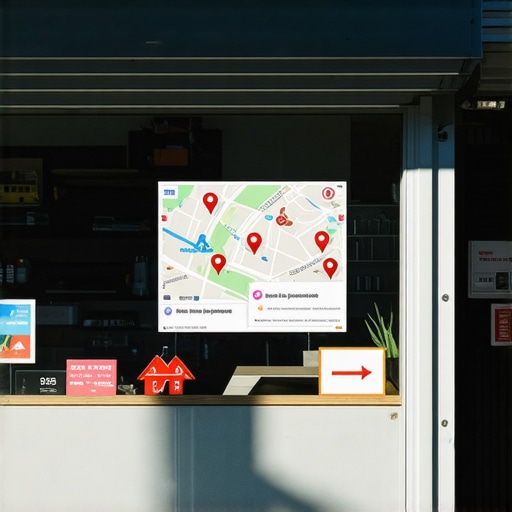
Why Random Mentions of Your Address Are Sending Local Customers to Competitors
The “Invisible Leak” in Your Local Strategy
You are likely checking your dashboard daily. You see the reviews coming in, you’ve optimized your services list, and you’ve uploaded high-resolution photos of your latest project. Yet, when you look at the Map Pack, your business is nowhere to be found, or worse, it’s buried under a competitor who hasn’t updated their profile in three years. This is the “invisible leak” that plagues thousands of small businesses: the silent destruction of your local authority through NAP inconsistency.
NAP stands for Name, Address, and Phone number. In the world of google business profile seo, these three pieces of data are the bedrock of your digital identity. When you have “random” mentions of your address – perhaps an old suite number from three years ago, a variation where “Street” is abbreviated as “St.” on one site but “Str.” on another, or a completely different zip code on an old Yelp listing – you are sending a signal of unreliability to Google. These aren’t just minor typos; they are data fractures.
If you have ever wondered, “why is my google business profile not ranking,” the answer often lies in these discrepancies. Google’s algorithm is built on trust. If the search engine finds five different versions of your address across the web, it loses confidence in your physical location. When trust drops, your ranking drops. This is how local search optimization fails – not because you didn’t try, but because you left a trail of conflicting data that your competitors are now using to step over you. For a deeper dive into these technical pitfalls, see The NAP Data Errors That Quietly Kill Your Local Search Visibility.
How Google’s Algorithm Interprets Your Address
To understand why a simple suite number variation matters, we have to look under the hood of the local algorithm. Google evaluates local rankings based on three primary pillars: Proximity, Relevance, and Prominence. While proximity is often out of your control (how close the searcher is to your office), your address data directly influences how Google calculates your relevance and prominence.
Google needs to “triangulate” your location to ensure they are providing the most accurate result to the user. Think of Google as a digital detective. If your official website says “Suite 200” but a local directory says “Unit 2,” and a random blog post mentions your old address on Main Street, the detective becomes confused. According to research on local seo ranking factors, inconsistent NAP prevents Google from recognizing the business as a single, authoritative entity (Source: Rocket Clicks). When the algorithm cannot verify your “ground truth” address, it defaults to a safer, more consistent result – your competitor.
This lack of confidence is the primary reason businesses get stuck in the “Map Pack Graveyard” (positions 4 through 20). To move into the Top 3, you need a high level of data authority. Google uses these mentions (citations) as votes of confidence. If the votes are for different addresses, they don’t count toward your google map pack ranking factors. Using a professional google maps ranking service can help align these signals, but the fundamental issue remains: Google won’t promote a business it can’t verify with 100% certainty.
The “Citation Trap” and the Reddit Reality Check
Many business owners fall into what I call the “Citation Trap.” They hire a low-cost service to blast their information across 200 directories, thinking more is better. However, if that initial data is even slightly off, or if you move locations later, you’ve just created a digital nightmare. Local citations seo is about quality and consistency, not just raw volume.
Take, for example, a common scenario discussed on Reddit. A business owner moved locations in November and updated their Google Business Profile immediately. By February, they were still seeing their old address pop up in search results and their rankings had plummeted. They “submitted so many requests” to various directories, but the old data kept resurfacing. This happens because many smaller directories scrape data from larger ones. If one major aggregator has the wrong info, it “infects” the rest of the ecosystem. This is why citation building services must be managed with surgical precision.
I often recommend a google business profile audit tool to track down these ghost listings. Without a systematic approach, you are playing a game of Whack-A-Mole with your own brand’s reputation. If you’ve ever felt like the system is rigged against you, read more about The Citation Trap: Why Bulk Directory Listings Often Kill Local Trust to understand how to break the cycle of bad data.
Why Your Competitors Are Winning (Even With Fewer Reviews)
It is the most common complaint I hear as a consultant: “Why does that guy with 10 reviews outrank me when I have 100 and a 4.9-star rating?” The answer is rarely about the reviews themselves; it’s about “Data Authority.”
In the eyes of the algorithm, a competitor with a perfectly clean NAP footprint across 50 high-quality, relevant sites will almost always beat a “messy” profile with hundreds of reviews. Google views the clean profile as a more stable and reliable answer for its users. If you want to rank higher on google maps, you must stop viewing reviews as your only currency. While reviews help with conversion, google business profile optimization requires a foundation of technical accuracy.
Think of it as the “Three-Block Test.” If your business pin disappears from the map the moment a customer moves three blocks away, your data authority is likely broken. Google isn’t confident enough in your location to show you to a wider radius. To improve google maps ranking, you must prove to the algorithm that you are exactly where you say you are, consistently, across the entire web. Leveraging the right local seo software can provide the insights needed to identify where your competitors are gaining this data edge. For more on this, check out Why Your Competitors Outrank You on the Map Even with Worse Reviews.
The Step-by-Step Address Audit & Fix
Fixing your address mentions is a tedious but high-ROI activity. If you are ready to stop the lead leak, follow this local seo checklist to standardize your presence.
1. The Quote Search Audit
Go to Google and search for your phone number in quotes (e.g., “(555) 123-4567”). This will pull up every webpage where your business is mentioned. Look for any address that does not match your current Google Business Profile. Document every single one of them in a spreadsheet. This is the manual version of using a google business profile audit process.
2. Standardize Your Format
Pick one – and only one – way to write your address. If you are at “123 Main Street, Suite 4,” decide if you will use “St.” or “Street” and “Suite” or “Ste.” or “#.” Once you decide, update your website’s footer, your contact page, and your gmb seo tools to reflect this exact format. Consistency is more important than which specific abbreviation you choose.
3. Cleanse the Major Aggregators
Focus your energy on the big players: Data Axle, Neustar Localeze, and Factual. These aggregators feed data to hundreds of smaller sites. If you fix it here, the “trickle-down” effect will eventually clean up the smaller directories. This is a critical step in any google business profile seo strategy.
4. Automate and Monitor
Address data is not “set it and forget it.” New directories are created, and old data can be re-imported. Use a google business profile audit tool to monitor your NAP health monthly. If a random mention of your old address appears, kill it immediately before it affects your rankings.
Future-Proofing for 2026: AI Search and Citations
As we look toward google maps seo 2026, the importance of address consistency is only going to increase. With the rise of AI-driven search (like Google’s Search Generative Experience), the algorithm is moving toward a “knowledge graph” model. AI doesn’t just look for keywords; it looks for “verified facts.”
If an AI search engine is asked for the “best plumber near me,” it will only cite businesses it can verify with absolute certainty. If your address is inconsistent, the AI will view you as a “low-confidence” source and exclude you from the AI-generated summary. These local seo trends 2026 suggest that your digital footprint will be your most valuable asset. To stay ahead, follow these 6 Google Maps Ranking Hacks for 2026 Neighborhood Wins and ensure your google maps ranking tips are updated for an AI-first world.
Conclusion
Your address is more than just a place where you do business; it is a vital ranking signal that tells Google whether or not you can be trusted. Don’t let a “Suite #” typo or an old Yelp listing kill your revenue and send your hard-earned customers to the competition. A clean, consistent NAP is the foundation of any successful rank google business profile campaign. Audit your profile today, standardize your data, and watch your visibility expand. If you’re ready to take the next step, use professional tools to improve local search presence and secure your spot in the Top 3.